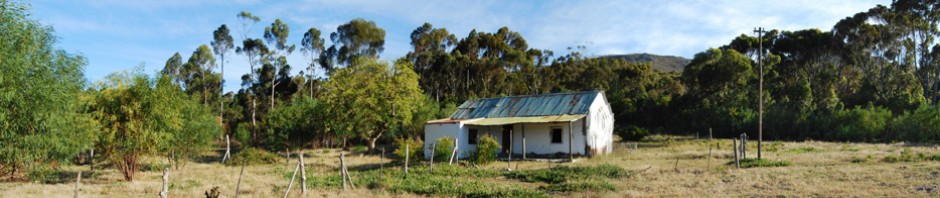
Sunday 19th May 2013

Will all the “Stuff” fit into the workshop?
The quick trip turned into two wild-goose days…. There was a forlorn hope of a few auditions for an “Elderly Black Man” for a Warner brothers movie, which would have paid for my petrol at least. As it turned out, there were no suitable gents in Cape Town who were interested in being a non-speaking extra in front of a grass hut in Africa. I also received an email from the leading acting school in Cape Town about a Seminar Christa and I had been asked to do. One of the tentative dates was Friday, so I was suddenly on stand-by to do that on my own. After a quick exchange of e-mails we all decided to wait until we were both available to do it.
Sorting and packing stuff from our minuscule back porch took most of Friday, so I left in mid rush-hour to drop off Christa’s security access card at CTFS on my way past, and arrived here well after dark.
I was up early on Saturday morning and took it easy, just enjoying the silence and the sunrise while having a breakfast of muesli and tea outside the cabin. I wandered out into Home Field to check on an experiment I’m running for my friend Vianne, but more of that later…
A quick walk to inspect the top dam turned into half an hour’s work – I just couldn’t resist wrestling another fallen tree in the East bank out of the dam and onto my pile of firewood nearby. I also managed to at least loosen and move the remaining huge grey tree trunk, but there is no way of removing it until I can borrow a fairly robust block & tackle.
Vianne’s Solar Distiller Experiment

Setup “A” on the left and “B” on the right. I removed the foil after just a day.
I’ve been mulling over a fairly sophisticated solar distilled water gizmo for several weeks, so it was curious that my friend Vianne sent me pictures of a solar distilling watering system made from recycled plastic water containers. Although I liked the simplicity of the idea, I had my doubts about the yield, so last week I set up two versions.
I didn’t have to walk very far on my property to find two five-litre wine cannisters discarded by itinerant inebriates and two one-litre bottles discarded by impecunious inebriates! The idea is to cut the bottom off the five-litre container and the top off the smaller bottle. The smaller bottle is filled with brackish water and placed under the larger one. In theory, the water evaporates in the sun, condenses on the inside of the improvised plastic dome, then runs down into the soil to deliver desalinated water to the plant.
I taped a foil tea-bag packet to the back of one of the jars, hoping to reflect more of the sun’s heat onto the water and improve performance. It was noticeable how quickly water droplets began to form inside this version, so I was optimistic.
The next day, however, my turbo-charged version appeared to be lagging behind, with a much lighter misting of water droplets. The reason became obvious when I peeked behind the foil. Since it was keeping the plastic warm, no vapour could condense on it. It was also probably keeping the front slightly warm, further reducing condensation, so I removed the foil and was immediately rewarded with condensation all round the covering bottle.
Eight days later, 30 mm of water has evaporated from each installation. Since the water containers are different diameters, that means that each has delivered different amounts of water to the soil, but in any case not enough to counter broader environmental effects. Humidity of the soil beneath the distillers has in fact decreased due to the hot dry weather during the past week. I’ve just “run the numbers” in a spreadsheet, with interesting results:
Distiller “A” uses a one litre cola bottle of 82mm diameter and has produced 0.1584 litres of water in 8 days. Distiller “B” uses a one litre fruit squash bottle of 77mm diameter, delivering 0.1397 litres. Temperature, airflow and humidity of a given environment being equal, the major determinant of the amount of evaporation is the surface area of the body of water, so I compared the yield in relation to the exposed surface area in each distiller. The results were so surprisingly consistent with the theory that I had to double-check my formulas! Distiller “B” has 88.1766805473 % of the surface area of Distiller “A”, and the yield per day is also 88.1766805473 % of the yield of Distiller “A”! Of course, ten decimal places of precision on such a rough experiment is ludicrous, but that is what spreadsheets do, and it does make the point!
Without a few tweaks, I doubt whether this method would provide sufficient water for even a balcony garden, although it might save your plants while you’re away for a week. Replacing the water container with a cut-off rectangular two-litre milk bottle would approximately double the surface area of the water, and therefore at least double the output of water vapour. (I don’t have a two-litre milk bottle to measure.)

Both units had lost 30mm of water in 8 days
Another suggestion would be to paint the water container black on the outside, which should increase the water temperature and improve evaporation.
It is also important that there is a flow of cool air over the outer bottle to dissipate heat from the water vapour to allow it to condense at all. I wonder whether piercing a few very small holes in the base at the back of the cover, and one or two near the top might help? Of course, some water vapour would be lost, but over-all the cooling effect might result in increased condensation.
*****

Klub Tessalonika ladies raise funds for the Senior Citizens
There was no point in unpacking the loaded pick-up until I had space to put the load, so I started by emptying the workshop. Just as I was contmplating lunch, Stephen Skyped me that the Old Folks club was having a Kermis (Fête) at the Dutch Reformed Church next to the School, so I took a walk down the hill. It seemed as though not many people other than the church’s own congregation were supporting the Fête though, so it was not crowded. I bought a delicious chicken curry, served in a margarine tub, and good value it was too, at only R10. Dessert was several generous chunks of candied watermelon rind dripping with syrup in a large yoghurt tub. Very swe-e-e-t indeed! I’m mindful of the fact that I fly to Johannesburg in just a few days, so I didn’t buy a bag of home made cookies, but later kicked myself for missing the opportunity.
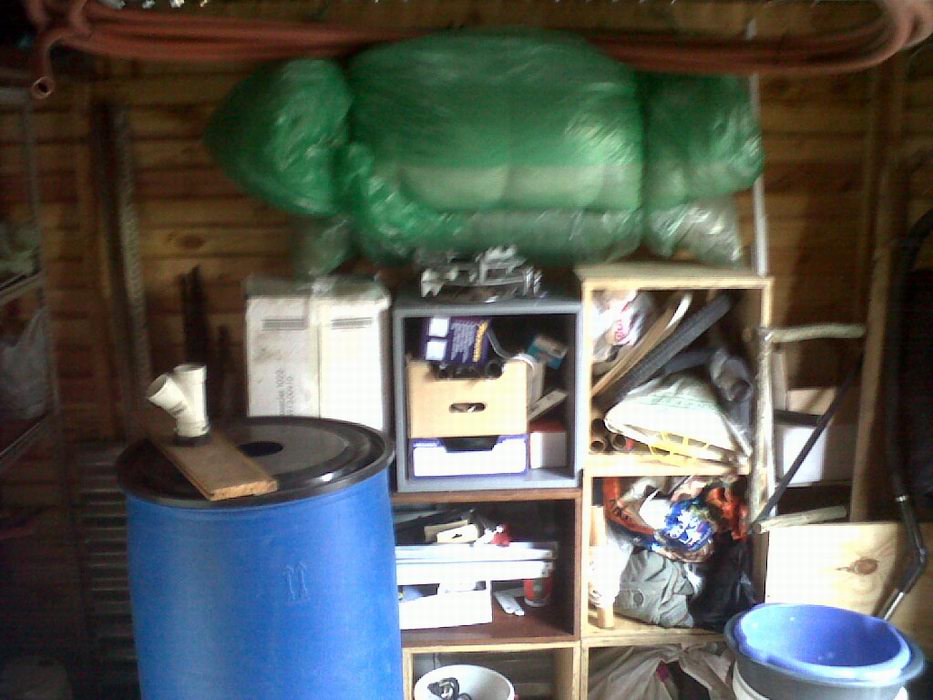
Stacking cubes allow for flexible storage
I had severe doubts about fitting all the “stuff” into the workshop, but the stacking boxes are very useful. Although they take up space, they also provide a greater variety of storage spaces, which is much more efficient. The biggest problem is going to be the sound damping blankets from a defunct audition studio. They look like huge duvets, and I’d left them in the sun to air. As the evening got chilly, I needed to get them inside to prevent them becoming damp again. By the time I’d roughly packed them on top of the digester drums there was a lot less room!
This morning I considered attempting to vacuum-pack the sound duvets, but didn’t bother because there are too many small holes in the plastic bags. Eventually I just rolled them tightly and restrained their attempts to become Michelin Men with ski-rope, before shrouding them in plastic and lashing the package to a roof-beam with more ski-rope.
Between sorting, packing and sweeping the workshop, I took frequent breaks to watch the week-end Arts and Technology programmes on BBC World News via my laptop. Although I have a cap of 1Gb per month, my rural ISP allows unlimited “carry over” when I’m not here. The download speed is normally faster than any other connection I have, but this week-end was frustrating, with several interruptions in every half-hour programme. Luckily, most programmes are repeated for people in different time-zones, so I’ve watched several presentations twice, hoping the breaks occur at different times! BBC journalism is so dense that one can miss a lot in the minute or two that it takes to reconnect.
Up early tomorrow to swap the pickup for the car, pack, and head back to Muizenberg – for more housework and packing, since I’m flying to Johannesburg on Tuesday night, for the first time in just on a year! There have been several developments on the work-front during the past few days, so Christa is saying I might be back in Cape Town sooner rather than later…