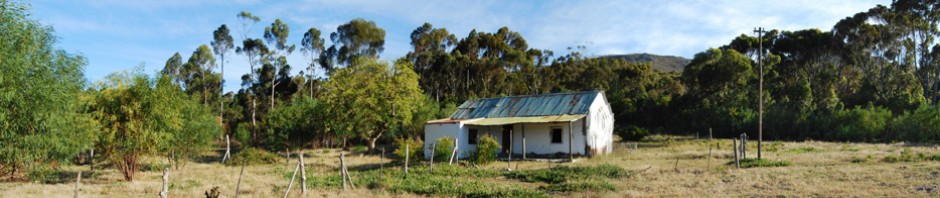
The house at Boggy Pond appears to have been built in three stages. The central section is clearly the oldest – the inner kitchen wall still has a gable-apex with an aperture for a loft door. Pastor Jordan, who now lives at the other end of the village, grew up in the house as the ward of his Uncle and Aunt, from whom he learned that the house was built around 1929 or 1930. Oom Jordan’s room was the stoep-kamer which he says had certainly been added by the end of the Second World war in 1945.

A view from the present bedroom through to the kitchen. The blanked off windows can be seen either side of the door
The West inner wall has small niches in it which were probably windows that have been planked up on one side to form “muur kaste”or wall-cupboards when the bedroom was added fairly soon after. The kitchen and stoep room were clearly added some time later – the construction is not as robust and the floor is a full 20cm lower. Either it was an easy way to avoid stepping the roof-line, or the inhabitants had got taller! (Not too far fetched, actually.)

- The packed stone foundation of the earliest section of the house
All the walls are of unfired mud-brick from 300 to 500mm thick, on packed stone and mortar foundations under the older sections of the house.

The collapsed West wall of the bedroomcan be seen to the left of this picture
The West gable has completely collapsed years ago and will be replaced with a modern cavity wall which will become the inner wall of a new bedroom with adjoining bathroom and “Eco-San” dry composting toilet. I’ve always had an issue with using expensive treated water to flush away poo anyway, and since water supplies are limited, we need to adapt to local conditions. The East gable wall is structurally unsound and will be replaced with a new cavity wall for the kitchen, “stoep kamer”, and new laundry.

A previous owner has replaced the collapsed gable with recycled corrugated roof sheet
There is no plumbing of any kind, therefore no kitchen or ablution facilities. There is at present also no electrical installation, although an Eskom cable terminates around the back of the house. Between the time we first saw the house and when I moved into my plank cabin, the pre-paid meter box was “liberated” along with about two meters of supply cable. I found the meter, now home to a colony of ants and insects, in the Blue Gum wood behind the cabin, with some charred plastic and rusted steel wire from the cable reinforcing. The copper cable was no doubt well on the way to China, via the local “Fence”!

The remains of the reed ceiling, above locally cut raw timber beams
When we first saw the house it had a very low, rather tatty plasterboard ceiling, but some kind locals saved me a choking day’s work by ripping it out and smashing what they didn’t wish to carry away for their own use, revealing the traditional “Riet plafon”.
I have fond childhood memories of the “Riet plafon” or reed ceiling in my grandmother’s house in Heidelberg (Cape) where we spent several holidays. Oiled or varnished reeds would be laid above rough-hewn beams or, in these simpler houses, de-barked tree-trunks. Often, a layer of mud would be laid on top of the reeds to form a fire barrier, as many of the older houses were originally thatched. This arrangement was known as a “brand solder” or fire-loft. If I can find a local source of reeds I would prefer to recreate the riet plafon, otherwise I might consider using saplings harvested from the continual effort to clear the invasive Blue Gum trees. Given the bureaucracy attached to repairing the ruin, perhaps I should plant my own crop of reeds now, which will be mature by the time I get around to installing a ceiling!

The green dashed box on the Plan view outlines the existing structure of the house. I’ve stepped back the bathroom for several reasons: Taking into account that we’re both getting older, we wanted the bathroom en suite, but didn’t want to indulge in the excess of a second toilet for guests, so placing the door close to the living room made sense. It will be a simple matter to use a portable screen as a room-divider in the bedroom if necessary; from an aesthetic point of view, I didn’t want to create a large slab-sided aspect to that view of the house. Originally the corner created by the offset could have been occupied by a large rainwater tank, but it will now provide a protected area for the underground part of the composting toilet installation if we decide to adopt it. That will depend on the experience of people in the village who have recently installed one. The architect has indicated a standard holding tank and omitted the grey-water reed bed. In spite of hosting Climate Talk Conferences, it seems that green expertise is a little lacking out in the sticks – exactly where it is most urgently needed! An initial discussion with a Plumber who used to hold a senior position at the local council was encouraging though.

The outline of the "piggy-back hearth" can be seen on the left
There is evidence of a collapsed “abba kaggel” or piggy-back hearth on the kitchen wall. These fireplaces were quite large, with a small window in the outer wall and a small free-standing cast-iron stove on the floor. A very sensible arrangement, since the heat from the stove would not be dissipated into the walls, but could circulate into the rest of the house in winter, or be allowed to escape through the open window in summer. There is no chimney shown on the plan because I felt at first that it would be redundant and complicate the best use of work space in the rather small kitchen. After talking to the architect, I’m having to re-think the omission as much for technical reasons as for aesthetics. The entire kitchen gable will have to be re-built, and tying a modern structure into the old mud-brick house is just asking for differential settling problems such as cracks and even further damage to the old structure. The new gable wall will need support to prevent it toppling. A buttress at either end would be in keeping with traditional Cape architectural practice, but so is an “abba kaggel”, with the further advantage of restoring the original appearance of the house. I’ve minimised the loss of work-surface by moving the gas stove into the hearth and moving the kitchen sink into the scullery / laundry.

The green line across the North Elevation indicates the existing wall height. At barely 2.1 metres, this is illegal for a habitable room under modern regulations. It is also too low for a modern door-frame! This is my own conceptual drawing, so it lacks the detail of guttering and so on. I have also not indicated the roof over the stoep. The large window to the Left (East) will be replaced by two smaller windows matching the rest of the house. The proportions of the house have been roughly maintained by keeping the total length of the house in proportion to the necessary increase in height of the walls.

Click on image to enlarge
I’ve decided to restore the “abba kaggel” which is such a distinctive feature of houses in the area. The large window designed to give a view of the wonderful gnarled tree Christa loves so much has been reduced to a standard window on the insistence of Heritage Western Cape. I’m mulling over a devious plan to use the loft window to direct more light into the kitchen.

Click on image to enlarge
The new bedroom and bathroom from the West. The window sizes are mis-matched – deliberately, as is quite common in houses in the area, which have grown organically as people’s needs have changed. The lean to (“afdak”) style of the bathroom and stoep room is also in keeping with local practice. I wanted a large window in the bathroom to make the most of the view of the Blue Gum wood. A double-size window was too overwhelming and would allow too much heat to escape in winter, so I’ve simply lowered a standard window almost to the top of the bath. I’ve added a loft door in this gable. Apart from being a common feature, it will provide access to the solar heating system.
Cape winters can be miserable – cold and wet, so the house will have solar-powered under floor heating. Rather than have conventional collectors visible on the roof, I plan to incorporate them into the roof sheeting, which will be painted a traditional dark Cape green. Integrating the solar collectors into the roof also provides insulation from the scorching summer heat and a means to dissipate heat during the night. A wind-powered pump system is on the drawing-board…

Click on image to enlarge
All that is some way in the future…. I now have to collect the plans from Heritage Western Cape and take them to the local council for approval.