Monday 20th December 2010
…at last! I think it’s called “Scratching at the Earth”, a phrase much used by journalists and writers when describing poverty-stricken subsistence farmers. They should try it themselves sometime… they might arrive at an understanding of why many small farmers remain in the grip of poverty. Farming without the benefit of mechanisation is damn hard work. I knew that of course, intellectually. Sweating away for several hours and feeling as though I was getting nowhere makes it very real.
On Sunday morning I took a spade an a recycled pool – chlorine bucket and quartered the property looking for cow-pats to work into the beds that Jeffrey has cleared. Well, right now they’re only two long patches of sandy soil denuded of the scrappy grass and stunted fynbos left after the alien trees have been cleared. My neighbour’s cows must have constipation, because I found surprisingly little evidence of their presence. I allow him to graze his few scrawny cattle here so that I can collect the free fertiliser they leave behind, but it seems the cows haven’t been told the whole deal. Mind you, there’s very little grazing here anyway. Perhaps they’re more hungry than constipated…
Trying to break up the drier offerings to make them fit into the bucket provided an illustration of why “misvloere” or cattle-dung floors were so popular amongst pioneers. Dried cattle dung is tough stuff – the embedded grass fibres work in exactly the same way as the glass or carbon fibres in modern composite materials.
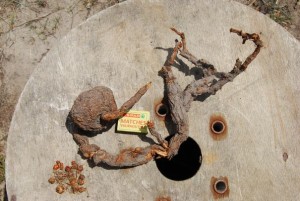
We found dozens of these dried grey tubers while preparing vegetable beds
Raking the dung into the beds to distribute it evenly revealed that there is more work to be done – the soil from the entire area will probably have to be dug up even deeper and sifted. I kept finding more of the apparently withered bulbs or tubers that Jeffrey had complained about.
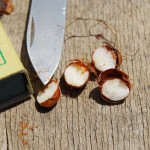
I found a handful of these "Mini Onions" close to or under each red tuber
Close to, or under, each I usually also found what look like miniature onions – smaller than a glass marble.
The tubers looked very dry and grey on the outside, almost petrified, yet when I cut one open it was a deep maroon inside and the woody texture glistened with moisture toward the centre. I suspect that they may well be a hardy fynos variety, bullied into dormancy by the alien trees that overwhelmed them.
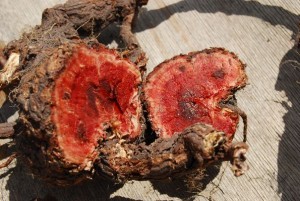
The plant is probably viable, since it still retains water in the heart of the bulb. If they are a variety of fynbos I shall re-plant them elsewhere in the cleared areas.
There seemed little point in carrying water to the bed if it has to be dug deeper and sifted, so I retired to the relative cool of the cabin with a new respect for subsistence farmers.
Unbeknown to me, a drama was taking place on the other side of town, downwind. One of the more well-to-do locals decided to have a braai next to his artificial-rock swimming pool. Inevitably, the bone dry grass next to his fence caught fire and spread rapidly. Half a kilometre up the hill my brother Stephen spotted the white smoke streamed along the ground by the driving wind. He dashed down to the source, and found the perpetrators doing absolutely nothing about the fire they had started. Stephen called the Caledon fire-brigade in and raised the alarm amongst the nearest neighbours, since a heavily laden tank-truck would take some time to get here. Luckily, one of the barley farmers in the path of the fire had already harvested his crop, so that blocked the fire in one direction. It was a close call for a partially built cob-house on the next hill though, since it has undisturbed fynbos right up to the front door. The local Fire-Chief was livid, as were other residents. I learned today that the perpetrators will be getting an Invoice for seven hours of fire fighting by two fire-trucks as an opener to the discussion about the fine…
A positive result is that plans are afoot to make us Fire fighting Reservists, give us training courses and base at least two light fire fighting bakkies in the town.
Here’s to your first crop!!! Cheers
Have to plant it first! Want to help dig in the compost?
Bring your own spade!
Thanks