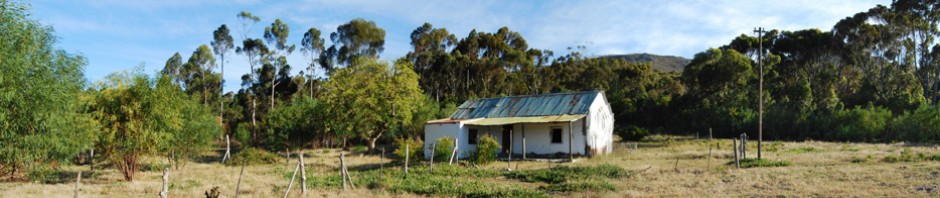
15th to 19th December 2011
 Three weeks have passed since my last post and I have left many a sod unturned. Not through lack of willingness, but through lack of time for things agricultural. By deciding to play by the rules I have dislodged an avalanche of paper – much of it a dull blue or brownish orange printed with pretty pictures of animals!
At first, I spent a lot of time in detailed e-mail correspondence with the Architect. Well, I wrote detailed emails – he would usually phone early the next morning for a chat. I would then fire up my CAD software to make the suggested changes to the plans, usually to keep “Heritage” happy. Cape Heritage is the guardian of any “structure” older than sixty years. Whether the original intention was to fossilise every pondok in the Western Cape or not, Theewaterskloof Municipality will not even look at building plans which have not been stamped by “Heritage”. Apparently, in other areas, “Heritage” is completely ignored.
As far as I can tell, the entire system is inconsistent. For example: your front door is rather creaky – the hundred year-old boiled-horse-hoof glue, being biodegradable, has, well… degraded! The cute little wooden window next to it only stays in the mud-brick wall because you don’t even try to open it. Time to replace them – that’s “maintenance”, so you don’t need building plans passed. Well then – go ahead! Go snap up that special offer and install a two-and-a-half-metre aluminium and glass sliding door in your house on the main road of the village! If you don’t ask, they can’t refuse, but because I’m doing the right thing it is going to cost me a sparrow-hop short of R10,000 before I’m allowed to stack one brick on top of another, let alone add a bathroom and toilet. Of course, if I choose to follow local custom and go ahead anyway, it could cost three times that in penalties, as some newcomers to the town have learned.
At the risk of writing a layman’s treatise on the preservation of Architectural Heritage, let me hasten to add that I am not opposed to the principle. I spent a year travelling throughout South Africa in the seventies filming a documentary series on the subject. It was a fascinating, and at times, a sad experience. In the Western Cape, where there are many “old” and therefore obviously worthy buildings, much has been preserved – not by regulation or legislation, but by ordinary people’s appreciation that even an average house may be part of the “index” to our cultural history. The further one travelled North, the less has been preserved, in part because development in the Transvaal for example was more recent, therefore less obviously worth preserving. Perhaps too, the culture of functionality began to hold sway, and with it a different perspective on “value”. The town of Barberton is an example – there is little or nothing left in the main street to hint at the town’s role as the centre of the Gold Rush of the Nineteenth century. In the Seventies, if one stood back a little – mentally and visually – you could see the plate-glass windows of national chain stores “bashed into” old buildings which should still have had windows no bigger than could have been transported on an ox-wagon. Clearly the vision was so fixed on conforming to the nationwide brand image of whoever owned the business, that the opportunity was missed to give the Brand a period feel which echoed the mining history of the town. With that went the opportunity to build a brand for the town which would have had enduring tourism value.
I don’t begrudge the man in our main street the flood of light through his new picture-window, but I can’t help feeling that if our focus had been less on “Governing” people by enforcing regulations and more on enlightening them about the benefit of preserving our built heritage, he might have decided to bash his picture window into the back wall of his house. Such a solution would have given the home owner a more sheltered area for family braais while preserving the tourism value of his street frontage.

Enjoy, folks, this is the only known photograph of me in shorts!
Could building a sturdy work-bench into the workshop be considered as “collateral agriculture”? First though, I needed somewhere to put the tools I would be using, and I had only a sturdy Dexian framework with no shelves in it. Timber is astonishingly expensive, so I came up with the idea of filling the frame with staves cut from the cartloads of saplings cleared from the fields. The problem is that they need to be cut to an exact length – for which one needs to hold them firmly in a bench vice. I had a vice, but no bench… Hmmm… The solution was to temporarily mount the vice on a thick beam I had found, then place that across part of the excavation for the biogas installation. (Still incomplete… because I need a work-bench…) I cut just enough to support some boxes and a few short planks I had, because it soon became evident that much of the wood had borer-beetle in it, and I don’t want to introduce borer-beetle into my wooden workshop! After all the bureaucracy it was a pleasure to be working with wood, creating a space that would, I hope, enable me to make other useful things. The bench was built in about a day, entirely from timber scavenged from the demolition of an illegal addition to our home in Johannesburg.

Begining to look like a workshop
While I was waiting for the plans to be completed, I travelled to Cape Town to work with Christa for two days, casting a UK comedy series. I’ve always been impressed with the professionalism of Cape Town actors in general, and this session was no exception. We’re looking for youngsters who can cope with either English or American accents to Lead or Supporting Cast standards. In two days of “Jocks and Babes” auditions there were no outright rejects. While some of the younger women, particularly, just don’t have the confidence yet to be thrown in the deep-end, the level of preparation, consistency of accent and response to direction was way better than what we have to “put up with” in Johannesburg. Oh, and everybody who had booked turned up, 99% with Résumé in hand. That doesn’t often happen in Johannesburg. I suspect that Cape Town actors have benefited from the international exposure, while Johannesburg actors don’t realise that there is a Film industry – and competition – beyond their TV Soapie horizon.

- Late afternoon in the Theewaterskloof valley near Caledon
After Christa flew back to Johannesburg on Thursday morning, I went to do some patch-up PR with one of the companies we work for often. On certain projects we work with a Cape Town casting director to keep travel costs down. This is particularly true of the “rats ‘n mice” parts – one scene, one day – which don’t warrant the expense. One of our collaborators has been causing headaches, extra expense and annoyance all round by simply not following instructions. Instead of uploading directly to our server, auditions are sent via “YouSendIt” link to us and the Producer, which means that a vast amount of video data first has to be downloaded and then uploaded again to be visible to the Execs in the UK. Previously, she had messed with files on the server and had trashed the entire site! I decided to create a ring-fenced safe area specifically for her and left for home on Thursday afternoon thinking that the problem had been solved…. “Yeah, right!” as Shakespeare didn’t say…

It is a work-bench, right?
Friday morning, up bright and early, breakfast, then into the workshop for another of those sublime moments at Boggy Pond. Between the newly installed vice and the drill press in the corner, I set up my new laptop to begin processing the video Christa and I had recorded in Cape Town. Well, actually the computer was bought second hand from an IT fundi friend of my nephew. Although we needed something more powerful than my seven year old laptop to process auditions while travelling, I still felt a little guilty about the expense… until I started the encoding.

Editing and Encoding our Cape Town auditions.
Wow! My desktop in Edit in Johannesburg is reasonably powerful and can process an audition in about 20% faster than real-time… this Dell Precision “portable workstation” chews up one minute of DV video in 31 seconds! Very handy, since I had nearly five hours of raw video to encode, and the British director wanted it ALL on our web site.
On Friday afternoon it was time to meet “my” Consulting Engineer. (Yes, this is just a vernacular house I’m restoring, not a soccer stadium!) He also brought with him several copies of the printed final plans which I would need to take to Cape Town for Heritage approval.
We took a desultory walk around the house, during which I received no advice and learned nothing new, other than that my R2,850 will buy me two inspections and a signature of approval. Design work – of the roof trusses, for example – “would incur an additional fee.” He said that I was not to worry though, once the plans had been passed the local Council Inspectors would hardly bother me after they’d inspected the foundations. A general chat provided an insight into the reason for all this paperwork:
In essence, expertise has been lost throughout the country in all spheres of public administration. People with minimal qualification and little or no practical experience have been appointed to administrative positions. They are disinclined to take responsibility, so the regulations have been framed to shift responsibility outside the departments, hence the need for the builder / home owner to appoint the consultants. People who should have got the jobs in the first place are now making a living, basically, by selling their signatures!
Unfortunately there’s a drawback in this system, as I see it. “Compliance” has rapidly come to mean compliance with the procedure and paperwork, not compliance with the intention – which is safe, durable, healthy buildings. The knowledge that the authorities lack the capacity to oversee all of this also appears to be leading to laxity and “fiddling” in the way the consultants do their jobs. The attitude seems to be “get the paperwork right, then do as you please.”
I had incorporated a waterless composting toilet and a grey-water reed-bed filtration and recovery system into my original design, rather than a water closet and septic tank. The plans came back with no reference to the reed-bed, just a bog-standard toilet and septic tank – if you’ll forgive the expression!
“I’m just trying to help you get your plans passed by your local council!” was the architect’s snappy reply when I raised the matter. Where does that leave me, as someone trying to build an eco-friendly house? I guess it will take a year and a confrontation with an Inspector to learn the answer…
I bade farewell to the Consulting Engineer and returned to the workshop to complete the last of the encoding, (the Jocks) having already encoded and uploaded the “Babes”. Unfortunately, or perhaps fortunately, I checked my e-mail…
The next obstacle to agricultural activity came via the internet. The casting director who had necessitated my public relations exercise had at last uploaded auditions to our server… six days in the studio, organised not by role, but by date, which is completely irrelevant! There were Folders within Folders within Folders, with running lists generically saved with identical names – not even a date appended! Just to really wind me up, they had clearly been uploaded from an Apple Macintosh, because there were what I call “Apple Pips” scattered all over the place. (Odd files of various sizes useful only to the Mac operating system.) There were also several Folders of full-size photographs, FOUR for each candidate, with no Role appended!
In fact, the total running time of video was way less than I had just processed, but sorting through it and moving it out of harm’s way to where I could link it to the web site would be a nightmare. Of course, the Producer urgently needed to see most of those characters…. Luckily our Director on the other project would only need to have access to our own Cape Town auditions after Christa’s Johannesburg session the next week, so I worked until the early hours of Saturday morning on the Cape Town mess, since that producer was about to get on an aircraft to fly home.

"Faw-Bah-Faws" of the local gentry parked outside Johan and Rina Nel's farmhouse

Beer and Boerewors under the trees at the Kontrei Braai at Solitaire
Every year a farmer from the Solitaire area about 4Km away invites other farmers in the ditrict to a “Kontrei braai” at his farm on a bend in the road to Shaw’s Pass and Hermanus. This year’s Sunday gathering was a little smaller and more subdued than previous years. It was also surprisingly very English-speaking. The Host opened the gathering officially in English, and the Pastor conducted Grace in both languages. The Boere are gradually being outnumbered by Rooinek refugees from the cities!
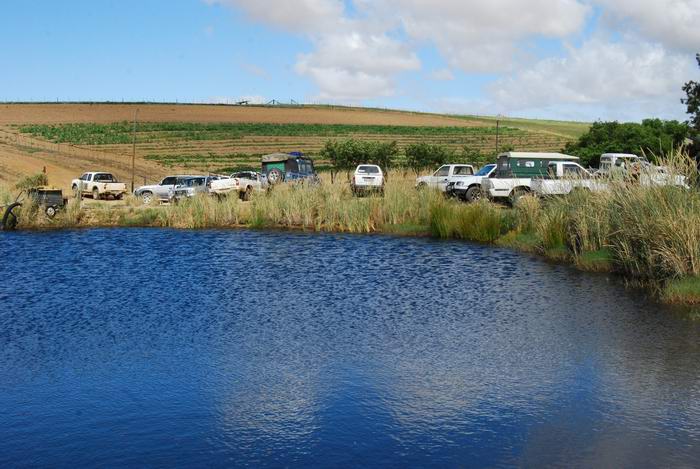
Plentiful parking around the dam under wide-open skies

Jeff removes dead wood from the clearing behind the cabin
Amidst all this Jeff would appear and I would give him whatever chore my addled brain could come up with. We made a start on the vertical-flow reed-bed for the cabin – which involved Jeff and a spade again, digging a hole that could be mistaken for the last resting place of a rather portly man! On days when he was a little… fragile… I set him easier tasks, like removing the dead wood from the clearing in the woods behind the cabin. If nothing else it was good to feel we’re making some progress in opening up the woods so that we can see the trees! It is also important because it has become clear that I will need to harvest as much run-off as possible and store it in several small dams, if I am to have any hope of growing crops. To plan the necessary drainage ditches, I need to be able to see the lie of the land, quite literally. Looking at the SA Weather Service historical records suggests that harvesting fog might be worthwhile too. The UNDP, I think, has successfully greened a desert in South America by stretching shade cloth between poles on mountain-tops and channelling the water to the village below. Of course I wouldn’t do it on that scale, but it appeals to the experimenter, the “Gyro Gearloose” in me. Given the level of wind here, the collectors would need to be protected in the woods.
After spending the rest of Monday scanning and correcting the Plans – the position of the house on the property plan was 22 metres in the wrong direction – and putting together a “Background, Proposed Work, Motivation and Conservation Approach” brochure required by Cape Heritage, I headed for Cape Town on Tuesday morning, a little later than I’d hoped, but by now I was fed up with the pressure.
The Heritage public counter closes at 12h00. Sigh!
I discover this when I arrive in the foyer of their headquarters on Greenmarket Square, and NOT on Heritage Square as proclaimed on their web site. I made the most benevolent hang-dog face I could muster and explain that “coming back tomorrow” involves nearly two hundred kilometres of driving from other side of Caledon again. The apprentice Mama at the security desk phones the Heritage desk, and I am allowed to go up to the darkened floor that is the seat of the Protectors of our Cultural Heritage. All the cultural experts had left the building at Lunch time on Friday anyway, according to a notice on the web site. The star-chamber that makes the big decisions only meets according to a fixed schedule, so if The Rehabilitation of Boggy Hovel needs to be decided at that exalted level, at least I’ve started the process. With any luck, some lesser god will return from The Holidays some time in January and just stamp the damn plans.
I was half-way to Wellington, to pop in on Chris and collect unwanted gypsum board to line the cabin, when I remembered that I hadn’t signed every plan print… ah well, I could always drive in for a pizza with Joe and Vi at the same time.
Of course, as I passed through Paarl, it started to rain, but there was no way I could stop to undo the load and cover it with plastic. We had loaded two scrappy boards on top, so I was hoping that they would be the only ones that got badly damaged. Driving through the Franschoek pass at night in rain and fog was quite character-building, but I took it very easy and the road was deserted, so the only danger was leg-cramps and a callus on my butt!
On Wednesday Jeff came up with the idea of storing the boards in the house, since it was threatening to rain again. We laid them flat on the floor and I have been turning them over every day since, so now they’re flatter than when we loaded them and all seem to be usable.

Villagers gather around a bonfire to sing Carols
 On Friday I decided it was time to catch up on three weeks of laundry while writing my neglected Blog before the evening’s “Carols by Candle Light” organised by “Club Tessalonika”, the pensioners charitable club in the village. I also needed to do some final tidying up on the Server, since we were a little over our quota… Oiiihhh Vehyyyiii… A simply massive upload appeared to be in progress, so I fired off a Text message, asking politely to be informed when the upload was complete.
 Several hours later I received an “Oops, Sorry” reply. Oiiihh Vehyyii indeed! Not only was it even more massive and unnecessarily complicated as previous uploads, but it duplicated many of the previous files! Sigh!! Well, the short version is that sorting out what to do with it took Christa and me most of Saturday, which also happened to be our seventeenth wedding anniversary. Thank goodness for my high-speed bundu-internet! I eventually backed up 435MB in 528 files to my massive portable hard drive at about three AM on Saturday morning – just in case!
I have had some fun amongst all of this. I generally listen to RSG, the Afrikaans radio service, because it has a great variety of programmes on everything from Literature, to Nature, Music and Astronomy. Even the phone – in programmes are generally bearable – I think they pull the plug on the really stupid callers! Although Afrikaans is technically my second language, it is also just a pleasure to hear just one of my languages spoken well. I’ve tried to listen to various local English language stations, but it is just too painful to bear, both because I can’t bear to hear my language being done “Vowelence” and because of the complete froth of the content. While living in a foreign country I picked up the habit of listening to the BBC World Service and I’ve been missing that station recently. Although I could listen via the internet, it seems a waste, since I have a good portable short-wave radio. While the whip antenna is passable at night, the radio performs better with a high long-wire external antenna, and I brought down about 25 metres of electrical house-wire for that purpose. Getting the wire into the first tree, near the cabin was fairly easy with my four-metre ladder and some climbing, but the tall gum tree at the other end was a different matter. The first fork was about eight metres up the clean bole of the tree. Too high, too narrow and too windy to use a throw-line. Using a throw line while standing on the top rung of the ladder seemed foolish – I didn’t want to get banged on the head by a rock if I missed… The other problem is that the trees will sway independently in the constant wind here and I didn’t want either a snapped antenna wire or spooky creaking noises being amplified by the wooden cabin!
I eventually got the antenna up and achieved good BBC reception on various short wave frequencies throughout most of the day. How? I’ll leave my friends Joe and Damon to ponder that with some amusement. Perhaps I’ll take a photograph and supply the answer next time.
I’ve been writing the latter part of this perched on a camp stool in a clearing behind the cabin, but the sun has gone and it has become quite chilly, so now that I’ve caught up, it’s time to make supper.