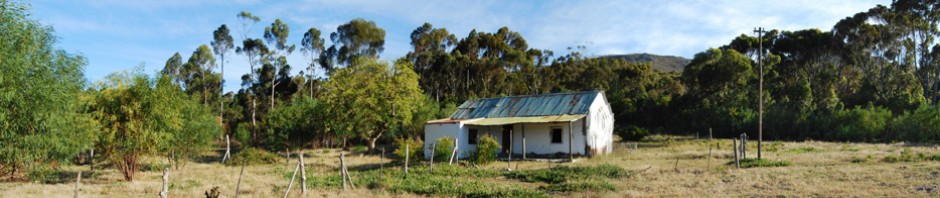
30th December 2011
Spent several days in the Workshop, doing a combination of little jobs and tidying / sorting as I go. Made a “lectern” to raise the laptop to a more ergonomic height when using an external keyboard. My major problem though is the lack of a comfortable office chair, so I’ll be ferreting around the second-hand shops in Hermanus in the New Year, when I go to visit Penny, back from her extensive travels this year.
 I also revived one of those silly solar powered automatic garden lights. They’re actually powered by two NiCad cells which are charged by the solar cell. Our set of two lasted about three months, which is not surprising, since NiCads develop a “memory” if used partially and recharged. The NiCads had grown an ugly fuzz, so I replaced them with two ordinary Alkaline batteries. (Yes, you can recharge ANY Alkaline battery – carefully!) The solar cell is not likely to overcharge these, so it should work just fine. I’ve mounted it near the door, so I have light when returning from a visit to Steve’s on a moonless night. I’ll repair the other one during odd moments waiting for glue to dry and so on, then mount it behind the cabin on the solar tower perhaps, to light my way from the bakkie.

Place to keep the Shopping
The problem with a pickup is that it has no luggage space! Well, by the time one has shopping, laptops, cameras stowed in the cabin, there’s no room for a passenger, and it isn’t “done” to charge past a villager on the road from town with an apparently empty seat. I’ve solved the problem by bolting a blue tin trunk into the load-bay behind the cab. Before I hit the road back to Johannesburg I also hope to make a cover for the load-bay out of thick re-enforced polystyrene sheet, a legacy of my years as a Lighting Cameraman, as the British call it. Although not up to Chubb Safe standards, it will keep any small loads out of sight, which is half the battle. The main reason though, is to streamline the bakkie a bit for long journeys to improve fuel consumption. Turbulence from the cab into the load-bay makes it about as aerodynamic as a plank outhouse with the door open!
The most important milestone though is that I’ve started in earnest on completing the Dangblasted Digester. In its simplest form, a Biogas Digester is – very simple! However, they are prone to stop working when the contents develop a crust of solids, shutting down the biodynamics. One solution is to install a paddle to stir the contents every few days, but every hole in the container increases the risk of either letting methane gas escape, or of allowing air in, which would stop the reaction. I have been amused by designs from well-meaning American universities hoping to uplift the Third World which use gas agitation. Pumping methane gas from above the feedstock to the bottom of the liquid to agitate it and break up the crust while it is thin is essentially a good idea. My cynical amusement arises from the fact that the academics have used an enormously expensive electric gas-pump to do it! If I can’t afford an expensive sealed gas-pump, how on earth is a small farmer in the wilds of Cameroon, the Sudan, or even KwaZulu going to?
After much drawing in the air, or trapping ideas out of the ether behind furrowed brow, I’ve come up with a solution using a simple hand-pump which doesn’t require an extra hole in the casing. Affronted Yankee academics would probably be quick to point out that my design requires some skill with hand-tools to make the three valves out of easily obtainable plastic plumbing and electrical pipe. Actually the level of skill is not high – it just requires patience and care. Let me be the first to point out that the phrase “easily obtainable” is in itself a huge assumption. People who spend their lives in cities – almost anywhere in the world – have no idea how quickly “first world” degrades into “backwoods and backward”. In central Europe, or a small country like the United Kingdom, a national chain store or hardware franchise is probably relatively nearby. In Africa or even – let’s say this aloud – in the United States, a comprehensively-stocked town may well be out of reach either physically or financially for rural folk.
Although I completed a CAD drawing of the design in principle a year ago, the concept of the re-circulating pump came later, and was incorporated in it’s essentials only. Instead of “Here Be Dragons”, my mental map was annotated in several places with “Here Be Challenges”. Purists may take issue with the use of so much plastic. Well, the plastic drums are re-cycled, much of the PVC plumbing pipe is scrounged and re-cycled, or at least left-over. PVC piping can be crafted with basic woodworking tools if necessary. The clincher, though, is that the conditions inside the digester are extremely corrosive. ordinary mild-steel piping would not last and it is not easy to work. My budget doesn’t stretch to brass or copper, let alone stainless steel, which is in any case beyond the facilities available in most home workshops.
One caveat about PVC is that I suspect that epoxy adhesives should be used sparingly and in such a way that the digester liquor receives minimal exposure to it, since epoxy contains a certain amount of formaldehyde compounds, which are poisonous to most organisms and could hamper the digestion process.
Anyway, moving beyond Chemistry! For a while I considered a diaphragm type of pump to avoid trying to seal a piston in a cylinder. I couldn’t be sure though of sealing a bladder made of inner tube, nor could I be sure of fabricating and actuating it in a way that wouldn’t stress it unevenly and so cause a rupture. A rupture would be catastrophic, with icky-poo and gas all over the place! By placing the piston above the fluid level I avoided the fluid leakage problem and avoided direct contact with the rubber seal of the piston. Time will tell, but I suspect that natural rubber might well be digested or at least degraded over time by the micro-organisms at work in the digester. Making a piston which seals well in both directions is important. On the one hand I don’t want gas to leak out, while on the other I have to keep air out of the system in order for the process to work at all. Meeting those requirements using an ordinary PVC waste-pipe of inconsistent internal diameter would require a very forgiving seal. Keeping air out and gas in was, even if I have to say so myself, a flash of simple genius – if it works. Simply make the cylinder long enough, so that when the piston is at rest – that is fully depressed – a head of water can be maintained above it which exceeds the designed head (pressure) of the system!
“X marks The Spot” where the piston would be was still labelled “Here Be Dragon-ous Problems!” though. Several failed experiments in Johannesburg left me frustrated, clue-less, and very loo-less! A casual chat with Wimpie, a plumber and proprietor of the hardware store I support, gave me the clue. He mentioned using half a tennis ball on the end of a stick to clear a drain… which is how I came to spend two days undressing, then very carefully dissecting a cheap Chinese “Flying Dragon” tennis ball.

The Tennis-Ball piston. (Click on image to enlarge)
I’ve cut two chords from the very centre of each hemisphere and mounted them back-to-back them on a length of “RediBolt”, or screwed rod. A little stiff at the moment because I’ve cut them conservatively over-size, but I’ll trim them after leaving them to settle into the cylinder for a few days while I make the three one-way valves required.

The blue valve plate will be fitted deepr into the adaptor, allowing the pump to fit into the top
The gas agitator works by drawing gas from the top of digester and pumping it to the bottom of the liquid. allowing the bubbles rise to the surface to lift and break up the crust. I’ve added a wrinkle borrowed from alluvial diamond mining. To vacuum the diamonds from the sea bed, a large hose is lowered to the bottom and air is pumped into the lower end via a separate hose. As the air-bubbles rise to the surface, they carry a large volume of water with them, which is replaced by more water entering the hose, carrying silt and diamonds to the surface. In the digester, gas bubbles will be confined in a tube ending just below the surface, angled to create a circular stirring action. Well, that’s my theory anyway.
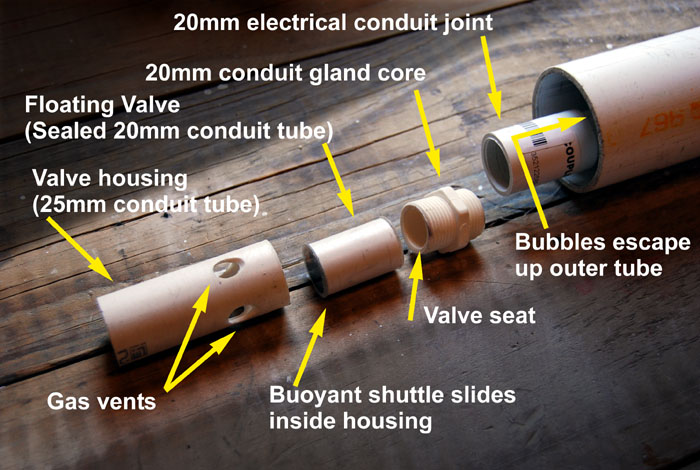
The most complex valve, near the bottom of the tank. It will be fitted flush with the bottom of the large tube, top right
The advantage of taking a long time to actually get around to making the innards of the digester is that I’ve been able to “mentally prototype” various solutions and discover potential problems. Sometimes I’ll come up with a “gizmo that does this or that”, then go to a hardware store or the Co-Op to just stare at the various fittings until I “recognise” something unrelated that will either do the job, or can be modified. At other times I’ll see something on the shelf that looks useful “for something”. I’ll pick it up, turn it this way and that, then put it aside. Sooner or later that input connects with a problem and becomes part of the solution. Either way, shop assistants are driven to distraction by this bonkers old Geezer apparently trying to fit an electrical switch-box onto a bit of plumbing hardware at one end and an irrigation fitting at the other. Heh heh…
Having worked out most of what I wanted to do by now, I have begun to tackle how to make what I need. Sometimes I have to take time out to make a tool to do a job – sort of making gizmos to make gizmos. In some cases I need to make more than one of the same thing, so it is worth taking the time to make a jig to ensure accuracy or consistency. I should be able to start assembling everything in a few days.
I’m taking it easy over New Year though. I seem to have been bitten on the left ankle by a nasty noo-noo, The inflammation of the ankle has not been improved by standing more or less still for ten hours at a time. Although the swelling seems to be diminishing, I may have to find a Doctor – just in case.