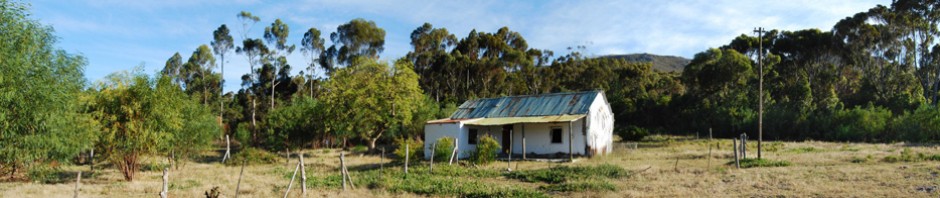
10th March 2012 – from Johannesburg.
I’ve been back in Johannesburg for three weeks already, and should be booking my flight back… that won’t happen until after Easter, so I might as well console myself with memories of the last week at Boggy Pond…
…Jeff had discovered that the main cable made a sneaky little bulge, leaving us with five metres of redundant ditch, luckily not the deepest part. The electrical archaeology had also delayed the completion of the new ditch, so on Thursday morning Jeff and I still had a lot of work to do when an Eskom car pulled up. A large, slightly aloof man unfolded himself from the passenger seat. I recognised Barrie as one of the guys who had installed the power cable to my cabin when I first arrived. Tyrone had driven him out, explaining that he was making use of every opportunity to get to know the area, the Eskom customers and the peculiarities of each site. In response to Barrie’s raised eyebrow at the already quite deep new trench, I explained that I still needed to dig it even deeper, so that it would be at least regulation depth after we had competed site levelling and that I preferred to have it well out of the way of the mini-bulldozer. He nodded and asked when I would be ready to have the power cut. I pointed out that Jeff had been ignoring my instructions to dig down only to the Eskom warning tape and leave the cable alone. Since he had been tugging mightily at the live 60 Ampere cable to pull it out of the trench for two days, was it really necessary to make another trip to switch off the power? He watched Jeff tugging at the cable yet again, suppressed a wry smile as best he could, then said quietly in Afrikaans “You have a point! Go ahead when you’re ready.” After briefly reminiscing about having to help dig the bit of trench across the road for the cabin cable, he and Tyrone went on their way.
While Barrie immediately understood the rationale of the deep trench, Jeff didn’t at all and was digging half-heartedly, so I drew a sketch in the sand. He understood finally, and set about digging again while I went back to try to get some order in the cabin and workshop. He hadn’t finished by knock-off time, because working in a deep ditch only a spade wide is very awkward. Jeff had also hit a curious patch of sandstone boulders. Luckily they only occurred near the required depth and only for about a metre, but each one had to be dug around and removed from the trench.
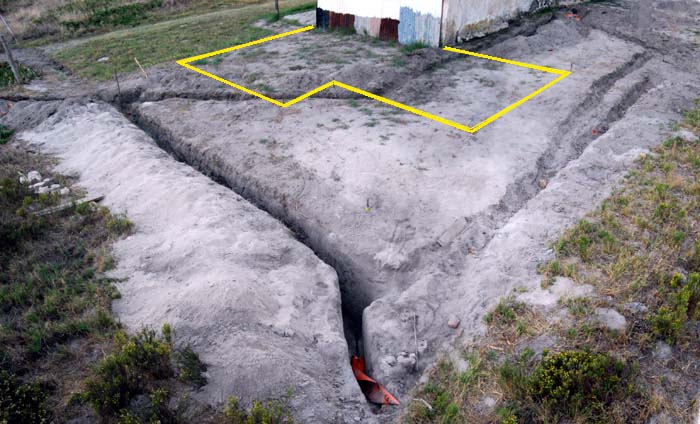
The yellow overlay marks the proposed bedroom and bathroom addition
Jeff came in for a half-day on Friday to do more digging while I started on the lining of the back wall of the cabin. I was more than a little peeved with Jeff at lunch time knock-off, because he had exposed almost the whole length of cable. I had at least stopped him from lifting the thinner 20 Amp. cable that ran to the cabin. I was uneasy about leaving the cable exposed, so I made sure I was very visible around the house until late dusk.
Of course, somebody did try to take the cable that night. On Saturday morning I discovered that an attempt had been made to dismantle the epoxy-encased joint and “the Jeffrey method” had been applied to rip the cabin cable out all the way to the hard ground at the head of the new trench. Clearly, I would have to finish all the digging, lay the cables and fill the trenches again by nightfall.
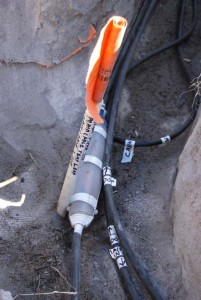
The rolled-up Eskom tape will provide early warning when we start to level the site
I also took some trouble to mark the trenches clearly at the expected new ground level. It was quite a job to replace so much sand, and it did take the whole day. Not surprising, since one end of the trench was just under two metres deep!
It was very satisfying though.. especially when Jeffrey wobbled past at dusk just as I was finishing up. Although he was already well into his weekend fog, he clearly understood the size of the job, and after expounding unintelligibly at some length in admiring tones, he wobbled off again, turning his head back over his shoulder once or twice. An unwise manoeuvre in his condition!
On Monday I set off to fetch the paperwork from the architect in Stanford. It was a relief to see that the farmland in our area had escaped the fire – but the road through the coastal vineyards was a different story. The fire had only been stopped by the wide tar road, and had even jumped that in a few places. Most vineyards had been saved, with singeing around the edges, but there were dust-devils rising from the scorched, sandy earth around the cultivated areas. The farmers will find themselves dealing with floods and mud-slides if we have heavy rain next winter.
I then treated myself to a quick lunch with our friend Penny in Onrus. During our conversation – which touched on the reasons for the apparent spread of incompetence throughout bureaucracy – Penny mentioned an open talk to be given at the U3A Annual General Meeting on the forthcoming Wednesday, which she thought I might find relevant.
I recognised the name John Kane-Berman as a respected financial journalist and commentator from some years back. Perhaps the term “financial journalist” is too limiting, because Kane-Berman was always able to set Economics in the context of a broader South African socio-political picture. This Rhodes Scholar has been the CEO of the South African Institute for Race Relations (SAIRR) for some years, but still writes a fortnightly column for Business Day. Since I had hardly done anything “fun” in three months, I decided to treat myself to another trip to hear him speak.
I am not even going to attempt to précis John Kane-Bermans address – it is far too important to do him that injustice. I will say though that if you are in any way puzzled or frustrated by what has been happening in South Africa and what lies in the future, PLEASE follow the link below!
If you read nothing else, read this publication: http://www.sairr.org.za/sairr-today-1/research-and-policy-brief-revealing-the-master-plan-what-the-anc-has-in-store-for-south-africa-28th-september-2011
It is in essence the same speech I heard and is essential reading for anyone who thinks beyond the next episode of Isidingo or Sewede Laan. You might also like to go to the SAIRR web site and scrounge around: http://www.sairr.org.za
Since the meeting – and socialising – ended late, I stayed over at Penny’s cottage and went to another University of the Third Age (U3A) function the next morning. (An episode of the DVD series of “A Country Imagined” presented by singer/Anthropologist, Johnny Clegg.) Although I happened to have seen this particular episode of Clegg’s TV series, it was fascinating to observe the retired intelligentsia in their adopted habitat of Hermanus.
Of course, by the time I returned to Tesselaarsdal after lunch on Thursday, I had lost a day and a half of working time, but it was absolutely worth it. If I had not stayed over at Penny’s I would probably have had to sleep in my sleeping-bag on the floor. I had removed much of the shelving to install the lining, so the bed became the obvious repository of everything. I set to work immediately, because I had to!
By working into the night, I achieved a liveable cabin to wake up to on Friday morning, which was also psychologically important for me. I had to forge ahead with lining my cabin for two reasons; I would probably return during Autumn, so the additional insulation would be welcome during the cold and wet Cape winter; I also did not want to leave my stock of recycled gypsum board in the ruin, exposed to un-seasonal rain and passing vandals. I did various jobs at once – re-packing and tidying the workshop while waiting for the linseed oil to dry in the cabin, for example. As I cleared the workshop, I found suitable timber and brackets for a new shelf, which relieves the jumble in the “kitchen”.
I also made a cover for the load-bed of the pickup out of the polystyrene sheets with which I’d covered the load on the trip down. The idea is also to eliminate the turbulence in the load-bed to improve fuel consumption on the commute to Cape Town. Unfortunately that took longer than expected – once I had started strengthening the edges with left-over waterproof roof-paint and membrane, I had to keep going.
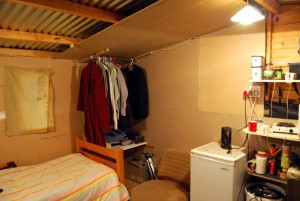
Getting cosier, but going to need a cheerful coat of paint soon
I was now getting quite good at the various jobs involved in installing the lining. The lower board is easy, but the upper boards have to be cut at the same angle as the wall and notched to clear the roof supports, which is fiddly and tedious to do since every one is different.
The biggest challenge was getting the first ceiling-board in without help, but genius – or a devious mind – will find a way! I managed to hold the board in place by temporarily nailing on some scrap wood to make swivelling toggles and supporting it on adjustable props assembled from lengths of timber clamped to a dexian shelving beam.
By Sunday, there was just too much tidying to do – re-installing shelves that I had taken down, sorting and re-packing the cabin and packing for the flight home, so I’ve left the remaining ceiling board to the tender mercies of the locals who ferret about the ruin. It will be interesting to see if it survives…
Monday 20th February was a long, long day! I didn’t want to leave the pickup in Cape Town for a month or two, but that left me with the problem of getting to the airport. Luckily, Stephen had a business trip which would take him near the airport, but that meant that we started very early on Monday morning to go via Wellington, Paarl and Somerset West before he could drop me in good time to catch the last flight out, back to The Big Smok…