4th June 2012
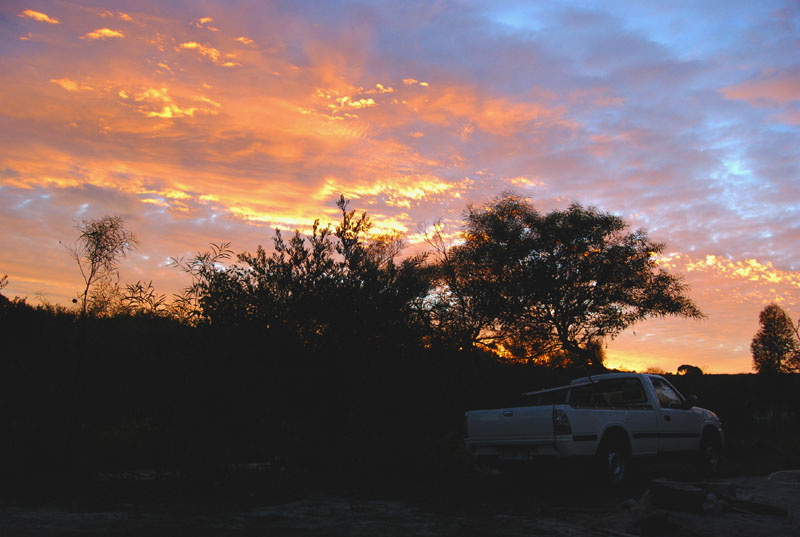
Sunrise after a light shower of rain at Boggy Pond

Sometimes two of these LBJs actually perch on the door-post
Early in the week I went to Poenie to scrounge in his barn for a typist’s chair Stephen had stored there – my junk-shop kitchen chair was just too uncomfortable, with the result that I am getting little or no writing done. As it happened, Poenie was having some earthmoving done near the house and the owner of the digger loader was offering a good deal while he was in the area. He had a trained operator on the machine, so it seemed too good an opportunity to pass up. At R300 per hour, with a minimum of five hours it was quite a chunk to lay out, but after thinking about it for a day I decided to go for it.
Of course one pays for the machine as soon as they start it up, so the half-hour trip to cover the four Km from Poenie’s cost R150 before we’d moved a single sod! I’d measured the levels using my improvised water-level, and estimated that they would have to remove half a metre of soil from the bedroom-end of the house, and nearly a metre from the kitchen/laundry end…
The weather forecast was clear and sunny for a few days, with rain at the end of the week, so I got Jeffrey started applying WakSol preservative to the workshop hut, then went to keep an eye on the digger.
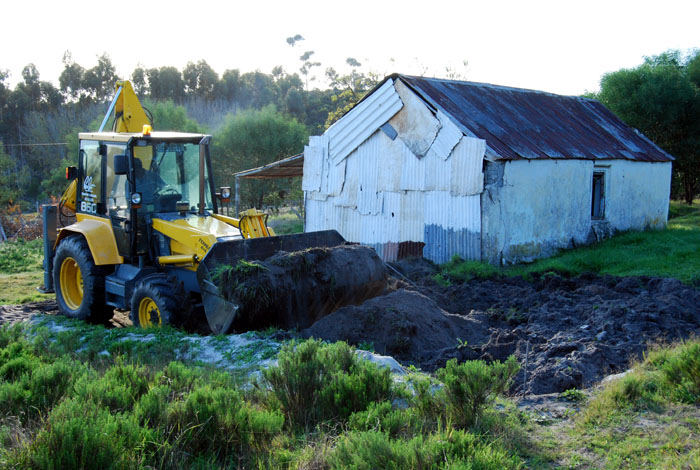 I had asked them to dump the sand in the field next to the house, on the edge of a shallow depression, with the idea that it would be easy to move it around a bit to form another small dam…
Ha! Pretty soon we needed to start another pile because the first was huge, and the only sensible place was in the depression itself, so that little plan will have to be revised!
As the digger worked along the back of the house I began to realise that I was probably making my first major mistake of this whole undertaking… If we continued simply following the level, the kitchen end of the house would be a full half-metre above ground, with the minimal foundations unsupported. We decided to gradually slope up to the existing ground level instead, and keep half a metre clear of the house anyway. It was also necessary to spend half an hour putting some soil back.
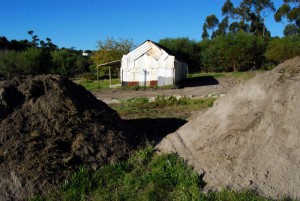
I now have two huge piles of sand to use somehow
With two hours left in the budget we moved to the West boundary, to clear a road to the corner post. On the one hand this would provide an alternative to my neighbours driving past the house up the middle of the property, and on the other it would also serve as a fire-break to keep the alien trees away from the Eskom power lines. Aliens have been growing and cut down by Eskom in that strip for years, leaving dozens of stumps that would take forever to remove by hand.
The supervisor – the owner’s son – was concerned about the stumps puncturing the massive tyres, so it was a case of first digging them out with the back-hoe, then turning the machine around to grade a few metres, then repeating the procedure. Progress seemed awfully slow, and at one point I was tempted to call a halt. At R9,000 per tyre, there seemed to be no point in having a very expensive half a road to nowhere!
I had mentally budgeted for an extra hour, in case we were “nearly there”, so we pushed ahead and arrived at the corner-post with a few minutes to spare. I couldn’t push further up the hill anyway, because municipal water meters and pipes lie just beyond, under a pile of rubble from the pipeline excavation, and I didn’t want to risk digging up a water-main! We curved the last bit of road towards a nasty erosion ditch on the unfenced next-door property – I would have liked to complete the road by filling the ditch and pushing another five meters to the existing road, but decided not to risk a charge of “Trespassing With Bulldozer”.
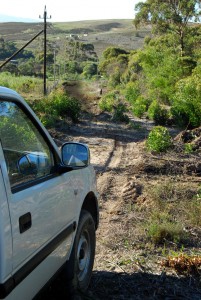
First trip up the new road
When the digger had left I couldn’t resist driving the pickup on my new road! Perhaps I’ll set to work with shovel and wheelbarrow to fill the ditch and dress the short distance to the existing road. Since the road runs directly downhill, I’ll certainly have to install a several humps before the rainy season to limit soil erosion.
I’ve set about manually excavating closer to the foundations of the house to get an idea of what to do next. A worrying aspect is the amount of damp just a few centimetres down. This is probably because the roof has no overhang and no gutters, so the run-off accumulates next to the wall.
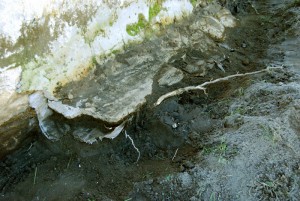
Tree roots and damp!
The kitchen section was clearly built later and some crude attempt has been made at waterproofing with plastic under a curved cement coping. There are also thickish tree-roots emerging from under the foundations, so it looks as though the house has been dropped on a giant rain-spider.

Milly Petersen
I was going to carry on with my “foundation archaeology” on Sunday afternoon, but received a text message from Steve. He’s confined to bed with a bout of bronchitis and had just received a call for help from the community. Family and friends of Milly Petersen had arranged a party for her in the Community Hall to celebrate her 60thBirthday, and the photographer’s car had broken down, so would I take the photographs? I was quite happy to do this for Milly, since she is a stalwart of the community, and one of the first people I had personal contact with. Milly and her husband have very little, but she and her daughters voluntarily cook meals for “Klub Tessalonika” every week. Tessalonika arranges talks, outings and craft activities for the elderly folk in the village. For many of them, the meals that Milly cooks are the only hot meals they get.
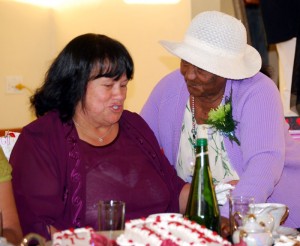
Tannie Lisa turned 94 on the same day
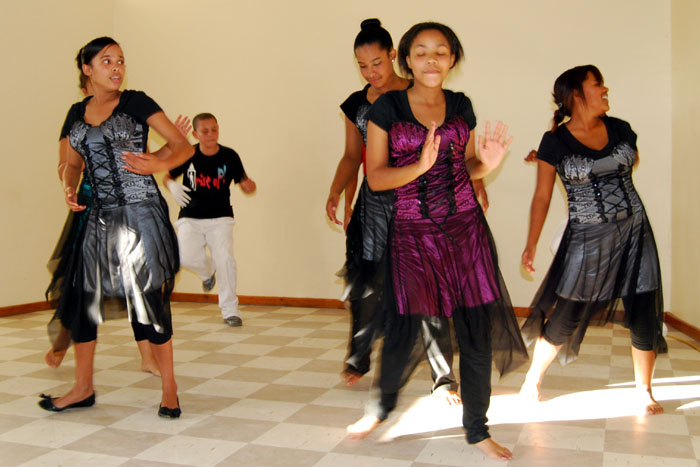
Milly has also cared for many foundlings and troubled children over the years. It was in many ways a humbling and sobering afternoon. Family and friends had gone to great lengths with very little but aluminium foil, local flowers, grape juice and a handful of snacks to decorate each table. Milly is a devout Christian, one of those quiet ones who just gets on with doing what she can with what she has to live her life according to the precepts of her Faith. Speaker after speaker, from her “adopted” niece to the local Magistrate, paid heartfelt tribute to this unassuming little Staffy Terrier package of goodwill, charity and service to her community. Girls and boys who had participated in the “TessFes” two years ago contributed a disco-dance performance they had resurrected. The honest simplicity of the afternoon was a sobering reminder of the vast gap in the social fabric of the country.