Friday 19th April 2013
Last week I spent so much time talking about life away from Boggy Pond I wrote nothing about my activities here…

Heavy rain and layers of clay under the sand combined to wash away the ramp onto my road
I started by just taking a walk-around, particularly up my Western road. I had graded it at some expense last year, and since it perforce runs straight downhill it suffered a little last September from the heavy rains pouring down from the fire-scarred mountainside, in spite of my efforts to put a few “speed-bumps” in place to channel the water away. The problem is that the soil here is generally sandy, but there are unpredictable layers of impervious clay at various depths under the surface. Water running down the hill of course seeps into the sand until it reaches the clay, then migrates downhill to emerge in inconvenient places – one of which happens to be at the top of the steep ramp at the foot of the hill – the entrance to my land. In spite of keeping surface water off the road, the sub-surface water in the heavily-wooded area next to the road emerged a few days later and completely washed away the track from under the ground. Embedded roots provide channels to conduct the water down the slope, as can be seen from the photograph.
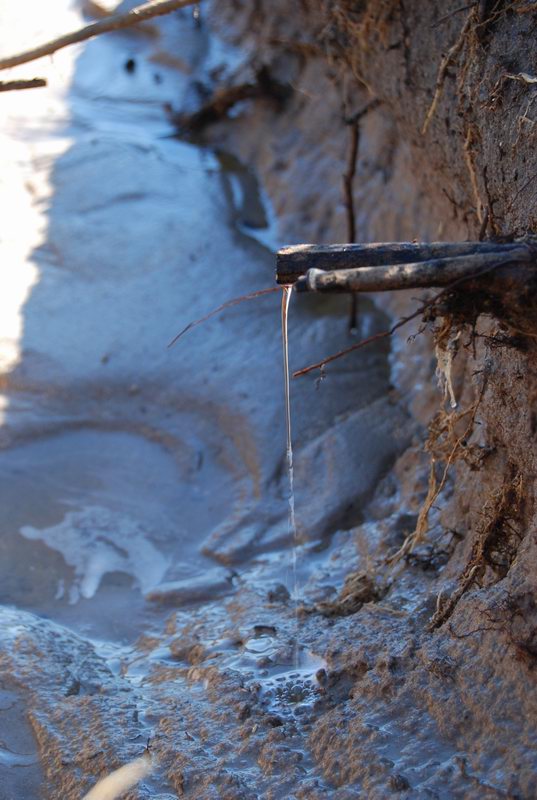
Tree roots also make very effective pipes to channel water underground
At the time, Jeff and I filled the gash with rock & stone harvested from the mountain, but there is no stopping water, and some erosion has clearly occurred since the start of this rainy season.
Fortunately the local Municipality finds my road very useful to access the area behind the housing development next door, which gets flooded every year because of what I can only describe as lunatic planning, so they generously dumped a few loads of building rubble to repair the damage. They also dumped building rubble at the very top of the road, which was washed away as collateral damage resulting from their emergency effort to direct flood water away from the RDP houses last year. They also destroyed the existing access road to the pig farm above me.

The new road to the pig farm up the hil, which curves East to join my boundary road. On the left, the RDP houses
In anticipation of this year’s rainy season, they have contracted a civils company to grade a new road to the piggery and dig a proper ditch across the back of the houses to direct the water down the hill – more or less straight at my road!

The drainage ditch above the houses in “Die Spruit”. How long these pipes remain unclogged by litter and sand will be interesting… “Die Spruit” could become very apt!
Luckily the contractor has turned the ditch quite sharply into the bush a little distance away, guiding it into an existing channel just across the boundary fence. They have also re-graded my road and replaced the silly 30 cm. pipe under our approach road with a much larger concrete culvert, which is apparently soon going to be secured by a concreted guide channel. If it doesn’t happen within a week or two, the brand new culvert is likely to be washed away cutting me and the Smal family off from the village.

The new culvert under my approach road, awaiting a concrete guide-channel
Jeffrey appeared – surprisingly sober – on Saturday morning, eager to be set to work, so I assigned him digging out the re-growth of alien saplings in the Northeast Field, while I tackled the Northwest. A few day’s work with mattock (bos-pik) and panga (machette) was necessary to protect the nearly R1,000 I had spent on a front-end loader to clear the infestation as soon as I arrived here, three years ago.
The fynbos has recovered quite well, but I was able to see the disproportionate effect ofthe Bluegum and Port-Jackson saplings.
___
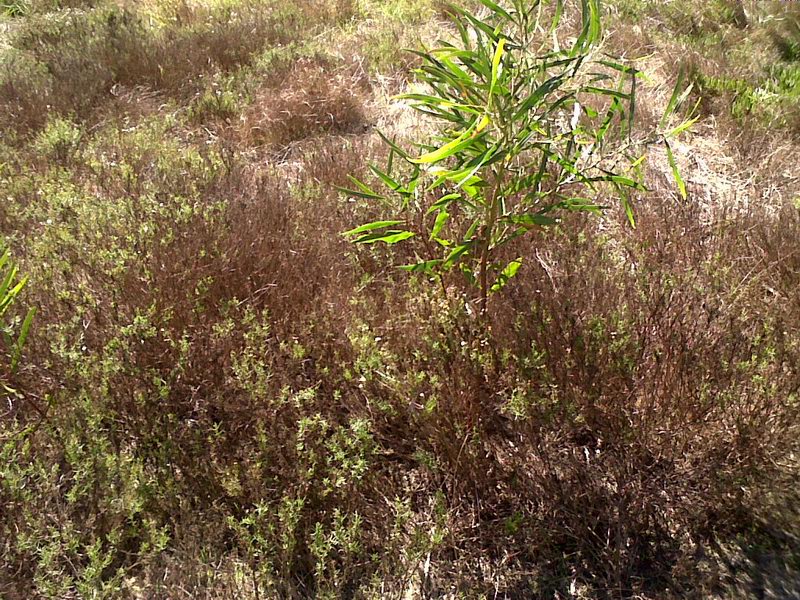
An alien sapling starves nearby fynbos of water, killing it
__
A single alien sapling appears to kill off fynbos in a radius of about half a metre around it, probably by starving it of water. Clearing the aliens is slow work – by lunch-time, Jeffrey and I had each cleared about half our allotted fields. Jeffrey had clearly lost his appetite for work, and I had developed blisters through my tattered gloves, so I decided to call it a half-day – it was Saturday, after all.
On Sunday I installed my last half-sheet of plasterboard as a side to my clothes storage corner – I wouldn’t call it a cupboard, let alone a wardrobe! The main reason was simply to get the board out of the way – I had stored it between my bed and the wall, where it snagged on the bedclothes. By the time I had swept the cabin thoroughly for the first time in a while, it was time to go to Steve & Sandy for a braai, after which I just took it easy, catching up on the Blog and watching the fascinating variety of BBC World News on my astonishingly fast Radio Internet connection.
I had auditions to run on Tuesday, so I was undecided whether to leave for Muizenberg on Monday afternoon or Tuesday morning, until I received an e-mail about a Community Meeting with the TWK Municipality on Monday evening. I’ve missed these very occasional events before, so didn’t want to do so again, especially as they are being increasingly well-attended by the locals. I only had four auditions late on Tuesday anyway, so I was glad of the opportunity to get more clearing work done too.
In the past, these meetings could apparently become quite argumentative, largely because the villagers had no clear understanding of the political and administrative limitations faced by the Local Authority. Monday’s meeting was more subdued, partly because it was largely a feedback session from the Council, and partly because the financial news was sombre. Although the TWK Municipality performs quite well in Administrative terms according to an independent report presented, the harsh fact is that it is a large area encompassing many poor rural communities, so it has a very restricted revenue base.
This situation is by no means unique in South Africa. Many local authorities find themselves squeezed by unrealistic promises made by central Government and a lack of finance, exacerbated by “lack of capacity” due to inexperienced staff. I believe we are heading for a gradual, whimpering collapse unless a concerted effort is made to enthuse villagers and small-town folk to undertake their own basic maintenance and improvement projects. For that system to work, though, central Government has to back off its attempts at “oppression by regulation” as I call it. Too many rules made in the Parliamentary ivory tower simply cannot be applied to impoverished communities. The other barrier to community action is that we essentially have to change the very psyche of the great mass of South Africans… we have to shake people out of their “hard done by” passive Socialism and foster a culture of active community building.
Quite how we do that is the subject for a very different blog… for now I’m faced with perhaps earning a place in this community half a field at a time…